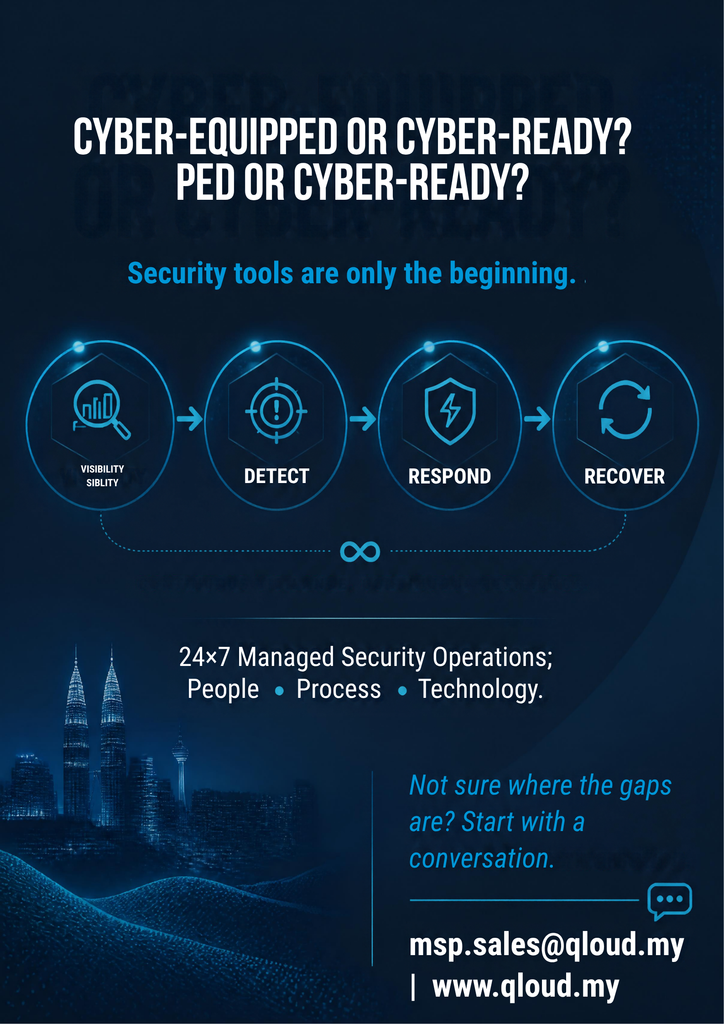

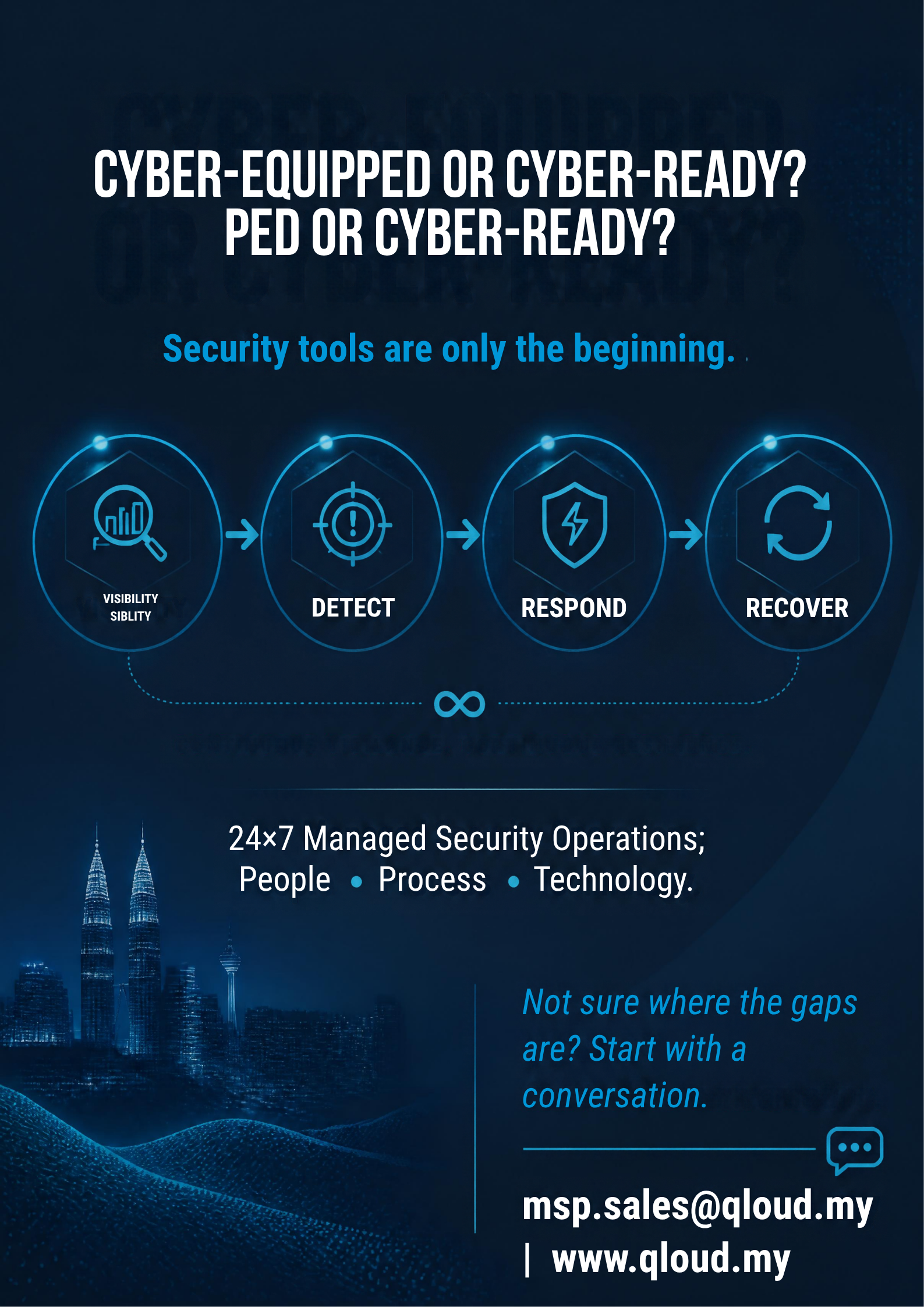
Having Security Tools Is Not the Same as Being Cyber-Ready
Most organisations today are no longer starting from zero when it comes to cybersecurity.
They may already have firewalls, endpoint protection, email security, backup solutions, multi-factor authentication and other security technologies in place.
Yet an important question remains:
If a cyber incident happens at 2 AM, who detects it and what happens next?
This distinction separates being cyber-equipped from being genuinely cyber-ready.
Cybersecurity readiness is not simply about how many security products an organisation owns. It is about whether its people, processes and technologies can work together to identify, investigate, contain and recover from an incident when it actually happens.
Malaysia’s Cyber Risk Environment Continues to Evolve
CyberSecurity Malaysia’s Cyber999 Incident Response Centre reported 2,715 incidents in Q2 2026, compared with 2,188 in Q1 2026 an increase of 24.09% quarter-on-quarter.
Reported data-breach incidents increased from 124 to 175, or 41.13% over the same period. CyberSecurity Malaysia notes that these figures represent incidents reported to and handled by Cyber999, rather than every cyber incident occurring in Malaysia. Cybersecurity
This distinction matters, but the trend still provides organisations with an important reminder: cybersecurity should increasingly be treated as an operational capability rather than simply an IT procurement exercise.
Malaysia’s regulatory environment is also developing. The Cyber Security Act 2024 (Act 854), which came into operation on 26 August 2024, establishes responsibilities relating to National Critical Information Infrastructure (NCII), cyber threats and incidents, while also regulating certain cybersecurity service providers. NACSA
For organisations operating in or supporting critical environments, cybersecurity governance, monitoring and incident-response capabilities are therefore becoming increasingly important.
The Cybersecurity Readiness Chain
A practical way to assess cybersecurity readiness is to examine six connected capabilities:
1. Visibility
You cannot protect what you cannot see.
Organisations should understand their servers, endpoints, networks, cloud workloads, applications, user accounts and other critical assets.
Security blind spots can leave suspicious activity unnoticed even when multiple security products have already been deployed.
2. Monitoring
Security systems generate enormous amounts of information.
The operational question is:
Who is watching it?
Monitoring should help identify unusual behaviour, suspicious events, availability issues and indicators that require further investigation.
For organisations requiring continuous operations, this may also mean considering 24×7 monitoring capabilities.
3. Detection
Not every alert represents a genuine security incident.
Effective security operations need processes and expertise to distinguish between normal activity, false positives and potentially serious threats.
The objective should not simply be generating more alerts.
It should be identifying the right alerts quickly enough to act.
4. Escalation
Detection without escalation creates another operational gap.
Organisations should establish clearly:
Who receives the alert? Who investigates it? Who has authority to escalate it? Who needs to be informed if the incident becomes serious?
These responsibilities should already be defined before an incident occurs.
5. Response
Once a genuine incident is confirmed, speed becomes critical.
Depending on the incident, response activities may include isolating affected endpoints, blocking malicious traffic, disabling compromised accounts, investigating affected systems, preserving evidence and coordinating internal stakeholders.
Technology can support these actions, but an effective response also requires established processes and experienced people.
6. Recovery
Cyber resilience does not end when an attacker is contained.
Organisations also need to consider:
How quickly can critical services be restored?
Backup availability alone is not enough.
Recovery procedures should be understood, responsibilities assigned and restoration capabilities tested so that the organisation knows whether systems can actually be recovered when needed.
Five Questions Management Should Ask
A simple cybersecurity readiness discussion can therefore begin with five questions:
- Do we have sufficient visibility across our critical IT environment?
- Who monitors security events outside normal business hours?
- What happens when a suspicious event becomes a confirmed incident?
- Is our escalation and incident-response process documented and tested?
- Can we restore critical systems within an acceptable timeframe?
If these questions cannot be answered clearly, the organisation may already own good security technology while still having operational security gaps.
Where Managed Security Operations Can Help
Building and maintaining an internal security operations capability can require specialised expertise, processes, monitoring technologies and continuous staffing.
For some organisations, a Managed Security or SOC service can supplement internal IT teams by providing capabilities such as continuous monitoring, security-event analysis, incident escalation, operational reporting and access to cybersecurity expertise.
The objective should not simply be outsourcing cybersecurity.
A well-designed managed service should create a clear operating model between the organisation and its security provider:
People + Process + Technology
with clearly defined responsibilities, escalation procedures, reporting and service expectations.
This is particularly relevant because Malaysia’s Cyber Security Act framework also includes licensing provisions for managed security operation centre monitoring services. NACSA states that applications for cybersecurity-service-provider licences cover managed SOC monitoring and penetration-testing services. NACSA
From Cyber-Equipped to Cyber-Ready
Cybersecurity technology remains essential.
But technology alone does not determine how well an organisation will handle its next incident.
True cybersecurity readiness comes from connecting:
Visibility → Monitoring → Detection → Escalation → Response → Recovery
The key question for management is therefore no longer simply:
“What cybersecurity products have we purchased?”
It is:
“If something happens tomorrow, are we ready to respond?”
Assess Your Cybersecurity Readiness
Not sure where the gaps are?
Qinetics MSP can help organisations review their existing security operations, monitoring, escalation and recovery capabilities and identify areas that may require improvement.